Why Aluminum Is One of the Most Versatile Fabrication Materials
Why Aluminum Is One of the Most Versatile Fabrication Materials
Aluminum is one of the most widely used materials in custom fabrication because it can accommodate a wide range of project requirements. It is relatively lightweight, rust-resistant, easy to shape, and compatible with several fabrication methods. It can be cut, bent, machined, welded, assembled, and finished to create everything from simple frames to custom gates, railings, architectural panels, and equipment screens.
But aluminum’s versatility is not tied to just one property. Its real advantage comes from how those properties work together.
A material that is lightweight but difficult to shape would have limited uses. A material that is easy to shape but performs poorly outdoors would also be less practical. Aluminum offers a balance of weight, durability, workability, appearance, and design flexibility, which is why it is well-suited to many residential and commercial fabrication projects.
What Does Versatility Mean in Aluminum Fabrication?
In fabrication, versatility means that a material can be used in different forms, designs, dimensions, finishes, and applications.
Aluminum can be made into tubes, channels, angles, sheets, slats, louvers, panels, posts, rails, and other profiles. These components can then be cut and assembled based on the property's actual measurements and requirements. This gives fabricators more freedom to create functional products without looking overly industrial.
The same material can be used to make:
- A modern driveway gate
- A decorative pedestrian gate
- A stair or balcony railing
- A louvered equipment screen
- A privacy panel
- A custom architectural frame
- An enclosure for outdoor mechanical equipment
However, versatility does not mean that every piece of aluminum is suitable for every project. The alloy, thickness, profile, finish, and overall design still need to match the intended use.
A railing, for example, has different requirements from a privacy screen. A driveway gate must account for movement, hardware, weight, and wind exposure. An equipment screen must conceal machinery without restricting airflow or maintenance access.
The material is flexible, but the design still needs to be deliberate.
Aluminum Is Lightweight Without Being Fragile
One of aluminum’s most useful properties is its relatively low weight.
This makes aluminum easier to handle during fabrication, transportation, and installation compared with heavier metals. It can also reduce unnecessary weight in products with moving components, such as gates.
A heavy gate can place more stress on its posts, hinges, rollers, tracks, and gate operator. Aluminum allows a fabricator to build a substantial gate without automatically adding excessive weight to the system.
That does not mean every aluminum product is light or that aluminum is always stronger than steel. Strength depends on the profile, thickness, alloy, frame construction, connections, and design.
The more useful way to think about aluminum is through its strength-to-weight relationship. It can provide the strength needed for many architectural and exterior applications while keeping the overall product manageable.
This is especially helpful for:
- Driveway and pedestrian gates
- Removable equipment-screen panels
- Large privacy-screen sections
- Balcony and stair railings
- Custom frames
- Sliding or automated gate systems
The goal is not simply to make the product lighter. It is to use the appropriate amount of material for the function it needs to perform.
Aluminum Can Be Cut and Machined for Precise Designs
Custom fabrication begins with accurate measurements. Once a design has been created, aluminum profiles can be cut to specific lengths and prepared for assembly. Machining may also be used to create openings, mounting points, connection details, or spaces for hardware.
This matters because custom projects rarely involve only straight pieces joined together. A pedestrian gate may need preparation for a latch, lock, electric strike, keypad, or access-control system. A railing may call for precise transitions between stairs, landings, balconies, or corners. An equipment screen may need removable panels, service doors, or access points.
Cutting and machining allow the components to be prepared around those requirements instead of forcing the property to fit a standard product. This is one of the main differences between custom aluminum fabrication and standard aluminum installation.
Standard products are manufactured in predetermined sizes and designs. Custom-fabricated aluminum is measured, designed, and built around the actual opening, layout, use, and appearance of the property.
Aluminum Can Be Bent and Formed Into Different Shapes
Not every fabrication project is made from perfectly straight lines. Properties may have slopes, unusual openings, architectural curves, angled walls, uneven elevations, or existing structures that the new product must work around.
Aluminum can be bent and formed to create:
- Angles and transitions
- Curved components
- Decorative details
- Custom panel shapes
- Frames for irregular openings
- Sections designed around slopes
- Architectural features that follow the building’s design
This gives property owners more options than choosing from a limited catalog of standard sizes.
It also means the fabricator can consider how the finished product will look as part of the property rather than as something added after the fact. A simple design can still look refined. In many cases, clean lines, consistent spacing, and correct proportions create a stronger result than adding unnecessary decorative details. The versatility of aluminum allows for both approaches.
It can support a minimal, modern design or a more decorative style, depending on the building and the owner’s preferences.
Aluminum Can Be Welded and Assembled Into Complete Systems
Many fabricated aluminum products are built from several individual components. Those components need to be joined into frames, panels, railing sections, gates, or screen systems. Welding is one of the methods used to create these assemblies.
For example, a custom aluminum gate may include:
- An outer frame
- Internal rails or pickets
- Privacy slats or panels
- Decorative components
- Hinge preparation
- Lock or latch preparation
- Reinforcement around hardware
- Mounting details
The frame must be aligned throughout fabrication. The spacing needs to remain consistent. The design must also account for how the gate will be installed and used. The same applies to railings and equipment screens.
A railing is not simply a collection of posts and rails. Its mounting points, transitions, corners, slopes, spacing, and connection details all need to work together. An equipment screen is not just a panel placed in front of a machine. Its frame, supports, louvers, access panels, ventilation, clearance, and installation method all affect its performance.
This is why custom aluminum fabrication should be treated as a complete process rather than a collection of separate parts.
Aluminum Profiles Expand the Design Possibilities
Aluminum is available in many different profiles, including tubes, channels, angles, bars, rails, posts, slats, and louvers.
Each profile can serve a different purpose. A larger tube may be used as part of a gate frame. Smaller profiles may be used as pickets, internal supports, or decorative elements. Louvers can provide concealment while allowing airflow. Channels and angles can help form frames, edges, and connection points.
This range of profiles allows the fabricator to select components depending on:
- The size of the project
- The amount of support needed
- The intended appearance
- The location of the product
- The mounting method
- The hardware being used
- The level of privacy required
- The amount of airflow needed
The availability of different profiles is one reason aluminum works across so many different custom applications.
The material can be adapted to the project instead of requiring every project to use the same shape and construction method.
Aluminum Supports Functional and Decorative Designs
A fabricated product must do more than look good. A gate must open, close, align, and secure the entrance. A railing must suit the space and provide the intended level of protection. An equipment screen must improve the appearance of the property without preventing the equipment from operating or being serviced. Aluminum allows functional requirements to be incorporated into the design.
A privacy gate, for example, can use closely spaced slats or panels to reduce visibility. But a more enclosed design may catch more wind, so the frame, posts, hardware, and installation need to account for the added wind exposure. An equipment screen may use louvers to help conceal HVAC units, generators, pool equipment, or utility systems. The angle and spacing of those louvers can affect both visibility and airflow.
A railing may be designed to match an existing gate, fence, balcony, or architectural feature. Its spacing and overall design must still account for how the area will be used. Aluminum’s versatility gives the fabricator more ways to balance these competing requirements.
Aluminum Is Well Suited to Many Exterior Applications
Outdoor materials need to tolerate changing conditions. In Sarasota, exterior fabricated products may be exposed to heat, humidity, rain, irrigation, salt in the air, landscaping, and regular sunlight. Coastal exposure can also vary significantly depending on the property’s location.
Aluminum is often selected for exterior fabrication because it does not develop iron-oxide rust in the same way as steel.
That does not mean aluminum is completely corrosion-proof.
Certain environments, incompatible materials, trapped moisture, damaged finishes, or poor installation details can still contribute to corrosion. This is why the material, finish, hardware, drainage, and installation method should be considered together.
For Sarasota properties, an exterior aluminum project may need to account for:
- Distance from the coast
- Wind exposure
- Standing water or irrigation
- Mounting surfaces
- Drainage
- Hardware materials
- Nearby landscaping
- Cleaning access
- Finish selection
- Maintenance requirements
The material provides a strong starting point, but long-term performance still depends on proper design and fabrication.
Powder Coating Adds More Finish and Color Options
Raw aluminum does not always provide the finished appearance a property owner wants. Powder coating can be used to give fabricated aluminum products a more consistent color, texture, and appearance. It can also add another layer of surface protection when the aluminum has been properly prepared and coated.
This allows custom-fabricated products to coordinate with:
- Window frames
- Exterior trim
- Roofing details
- Existing fences
- Building colors
- Commercial architecture
- Other gates or railings
A gate and railing system can be finished in the same color so they look like part of one coordinated design. Equipment screens can be finished to blend into a building rather than drawing more attention to the mechanical area they are intended to conceal.
The finishing stage should be considered early in the project. Fabrication, welding, drilling, and hardware preparation should generally be planned before the final finish is applied. Otherwise, later modifications may affect the finished surface.
Different Aluminum Alloys Can Serve Different Requirements
Aluminum is not one single material specification. Different aluminum alloys and tempers have different characteristics. They may vary in strength, workability, corrosion resistance, weldability, and suitability for certain fabrication methods.
The right material depends on the product being built.
A lightweight decorative panel may not require the same profile or thickness as a large driveway gate. A railing may need different structural considerations from a removable equipment-screen panel.
Material selection may be influenced by:
- Project dimensions
- Expected loads
- Profile shape
- Welding requirements
- Forming requirements
- Hardware
- Outdoor exposure
- Finish
- Mounting conditions
- Intended use
Property owners do not necessarily need to select the alloy themselves. However, they should work with a custom aluminum fabricator who understands how the choice of material affects the finished product.
Aluminum Works Across Many Custom Fabrication Applications
The versatility of aluminum becomes clearer when looking at the products made from it.
Custom Aluminum Gates
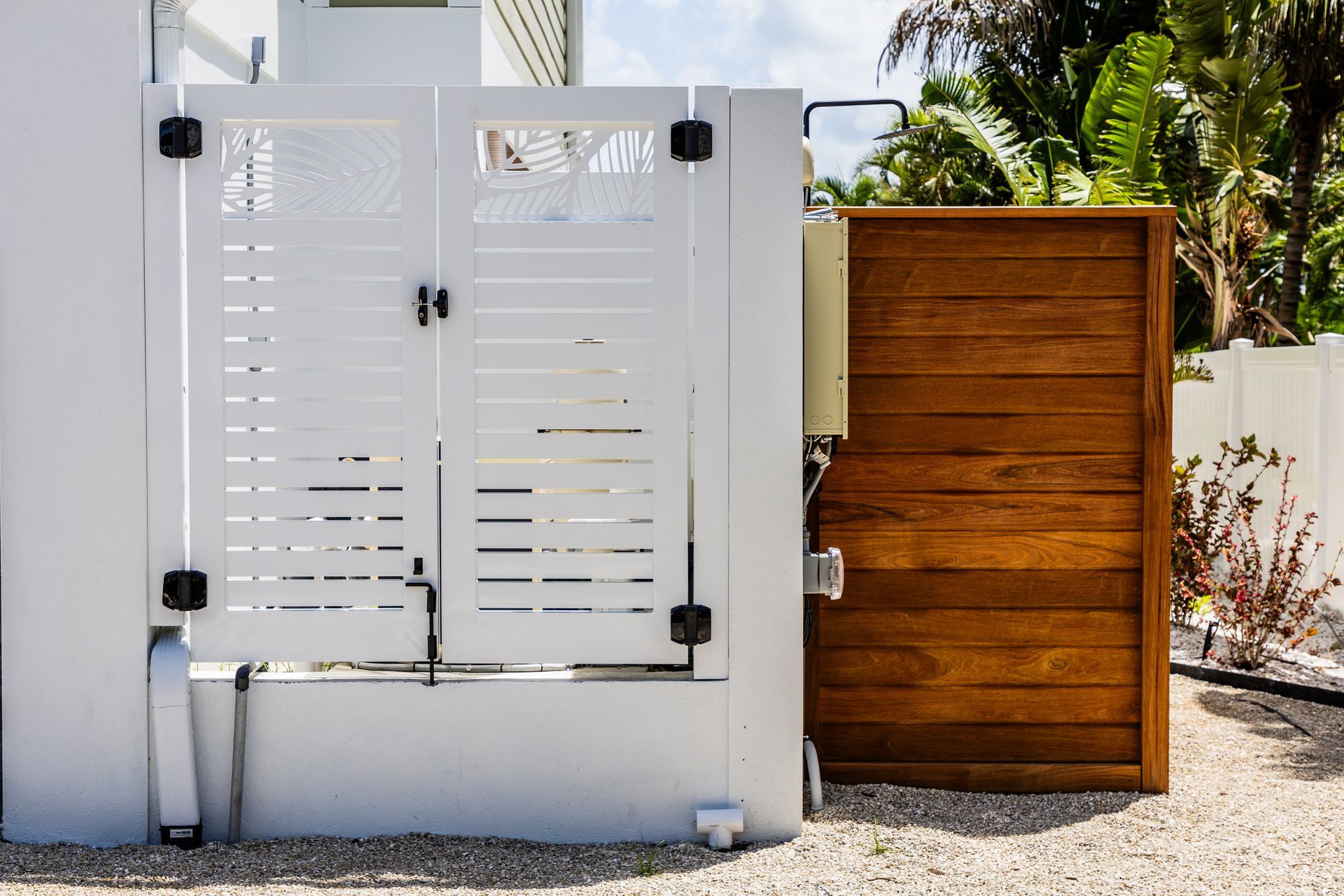
Aluminum can be used for driveway gates, pedestrian gates, swing gates, sliding gates, privacy gates, and decorative entry gates.
The design can include open pickets, horizontal or vertical slats, solid sections, louvers, decorative patterns, or a combination of different elements. A custom gate can also be prepared for:
- Hinges
- Latches
- Locks
- Keypads
- Card readers
- Intercom systems
- Electric strikes
- Gate operators
- Access-control equipment
The frame, posts, hardware, finish, and movement system should all be planned as one complete gate system.
Aluminum Railings
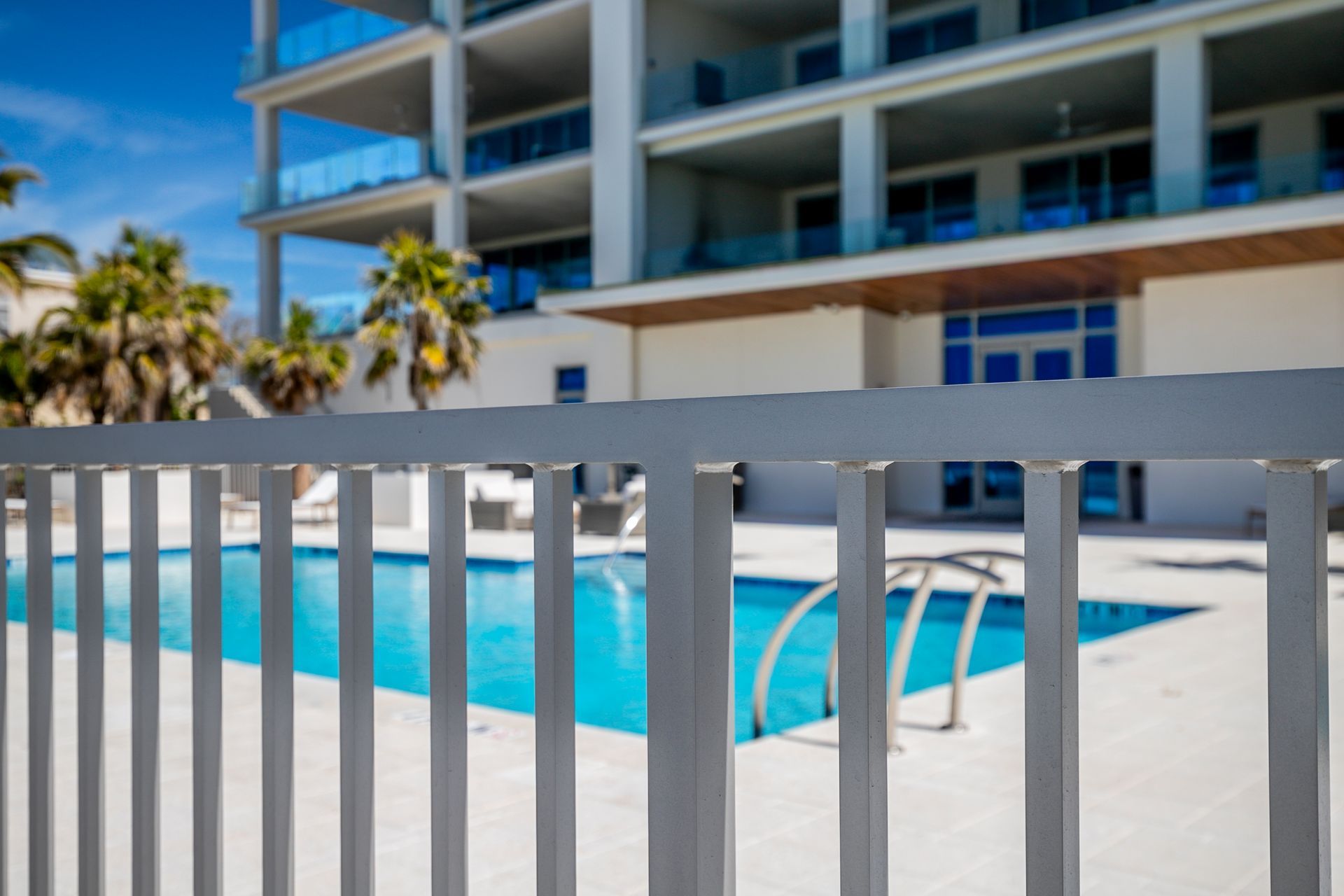
Custom aluminum railings can be designed for stairs, balconies, decks, porches, walkways, and commercial areas.
Aluminum allows the railing to be fabricated around:
- Custom lengths
- Corners
- Stair angles
- Landings
- Sloped surfaces
- Existing walls
- Mounting conditions
- Architectural details
A well-designed railing should fit the actual space rather than forcing a standard panel into a non-standard opening.
Aluminum Equipment Screens
Equipment screens are used to conceal outdoor mechanical systems while preserving access and ventilation. They may be designed around:
- HVAC units
- Pool equipment
- Generators
- Utility meters
- Rooftop systems
- Commercial mechanical equipment
- Service areas
- Waste or storage areas
Aluminum allows equipment screens to be built with slats, louvers, solid panels, removable sections, access gates, or custom frames. The screen should improve the appearance of the area without interfering with airflow, maintenance, equipment clearance, or operation.
Aluminum Can Be Used for Residential and Commercial Projects
Residential and commercial projects may use the same material, but they do not always have the same priorities. For homeowners, the focus may be on:
- Appearance
- Privacy
- Property access
- Matching the home
- Outdoor durability
- Lower maintenance
- Custom fit
Commercial properties may place more emphasis on:
- Larger dimensions
- Equipment concealment
- Repeatable panel systems
- Maintenance access
- Architectural consistency
- Installation coordination
- Property-management requirements
Aluminum can adapt to both types of projects because it can be fabricated into different sizes, profiles, panel arrangements, and finishes. The design should still be based on the property's actual use.
Aluminum Can Be Recycled and Used Again
Another advantage of aluminum is that it can be recycled and returned to productive use. This makes it relevant to property owners, architects, and contractors who are considering long-term material use.
Recyclability should not be the only reason to choose aluminum. A product also needs to be properly designed, fabricated, finished, and installed so it can remain useful for as long as possible. A poorly designed product that needs to be replaced early is not automatically a better environmental choice simply because the raw material can be recycled.
The strongest approach is to combine responsible material selection with durable, project-specific fabrication.
When Aluminum May Not Be the Right Material
Aluminum is versatile, but it is not automatically the best choice for every fabrication project. Material selection may depend on:
- Structural requirements
- Impact exposure
- Heat conditions
- Project size
- Moving loads
- Hardware
- Budget
- Desired appearance
- Building specifications
- Engineering requirements
Some applications may require a different metal or construction method. A reliable fabricator should evaluate what the product needs to do before recommending the material. The decision should not be based only on appearance or on the assumption that one material is always better than another.
When comparing aluminum fabrication versus steel fabrication, consider the complete project rather than focusing on one isolated property.
Why the Complete Fabrication Process Matters
Aluminum creates many design possibilities, but the material alone does not determine the quality of the finished product.
A custom project may involve:
- Site evaluation
- Accurate measurements
- Design and planning
- Selection of suitable aluminum profiles
- Cutting and machining
- Welding and assembly
- Hardware preparation
- Surface finishing
- Delivery
- Installation
- Final alignment and inspection
A mistake during any of these stages can affect how the product looks or performs.
Incorrect measurements can create fit problems. An undersized frame may not support the intended design. Poor hardware planning can make a gate difficult to use. An equipment screen without enough access may complicate future maintenance.
This is why custom aluminum fabrication should be coordinated from the initial design through installation.
Work With a Custom Aluminum Fabricator in Sarasota
Freedom Aluminum provides custom aluminum fabrication in Sarasota for homeowners, contractors, property managers, and commercial clients.
Projects may include:
- Custom driveway gates
- Pedestrian gates
- Aluminum railings
- Equipment screens
- Privacy screens
- Architectural aluminum features
- Custom measurements and design
- Aluminum fabrication
- Powder-coated finishes
- Installation
Each project should be designed around the property’s actual measurements, intended use, appearance, hardware, exposure, and installation requirements.
Aluminum is one of the most versatile materials for fabrication, but its full value comes from knowing how to use that versatility effectively. Contact Freedom Aluminum to discuss your custom gate, railing, equipment screen, or exterior aluminum fabrication project in Sarasota, Florida.