Custom Aluminum Pedestrian Gates in Sarasota, FL: Design and Security Considerations

Custom Aluminum Pedestrian Gates: Design and Security Considerations
A pedestrian gate may seem like a small part of a property, but it can affect how people enter, how secure the area feels, and how well the entire fence or entryway works.
A gate that looks good but drags on the ground, swings the wrong way, or uses the wrong lock can quickly become frustrating. The same is true for a gate that provides privacy but was not built to handle the extra weight or wind exposure.
That is why custom aluminum pedestrian gates should be planned around the actual property, not chosen from a catalog based on appearance alone.
For homes, businesses, apartment communities, and other properties in Sarasota, the design process usually consists of several practical decisions: width, height, swing direction, visibility, hardware, access control, finish, and the condition of the posts or columns supporting the gate.
All of those details need to work together.
What Is a Custom Aluminum Pedestrian Gate?
A pedestrian gate is a walk-through gate made for individuals rather than vehicles.
You will often see one at a:
- Side yard
- Front walkway
- Courtyard
- Garden entrance
- Pool area
- Apartment amenity
- Employee entrance
- Commercial walkway
- Service area
A custom aluminum pedestrian gate is measured and fabricated for a specific opening. Its size, frame, style, finish, hinges, and locking hardware are selected based on how the gate will be used.
This is different from buying a standard-size gate and trying to make it fit.
A prefabricated gate may be fine for a simple opening, but it may not work well when the ground slopes, the opening sits between existing columns, the gate has to match a railing, or the property requires a keypad or card reader.
Custom fabrication becomes especially useful when the gate needs to:
- Fit an unusual opening
- Match an existing fence or railing
- Connect to masonry columns
- Provide more privacy
- Support commercial-grade hardware
- Handle frequent use
- Work with an access-control system
Think About How the Gate Will Be Used
The best place to start is not the style. It is the purpose.
A small garden gate used a few times a week does not need the same frame or hardware as a commercial entrance opened throughout the day. Before the design has been finalized, the fabricator should know who will use the gate, how often it will be opened, and what may need to pass through it.
Residential Pedestrian Gates
At a home, pedestrian gates are commonly used for side yards, gardens, courtyards, front walkways, and backyard access.
Homeowners may be looking for:
- More privacy
- Better curb appeal
- A secure side entrance
- Pet or child containment
- A gate which complements the house
- Easier access to the yard
The right design depends on the location. A side-yard gate may need a keyed lock and a more private layout. A front courtyard gate may be more decorative and may include an intercom or keypad for visitors.
Commercial and Multifamily Gates
Commercial and multifamily properties often have different priorities.
The gate may be used by residents, employees, delivery staff, maintenance teams, or customers. It may also need to connect to a larger access-control system. These gates may require:
- Stronger hinges
- Self-closing hardware
- Keypad or card-reader access
- More durable locking systems
- Easier exit from the secured side
- Hardware designed for heavier traffic
A gate used throughout the day should be built for repeated movement. If the frame, hinges, or posts are undersized, problems tend to show up quickly.
Pool and Amenity Gates
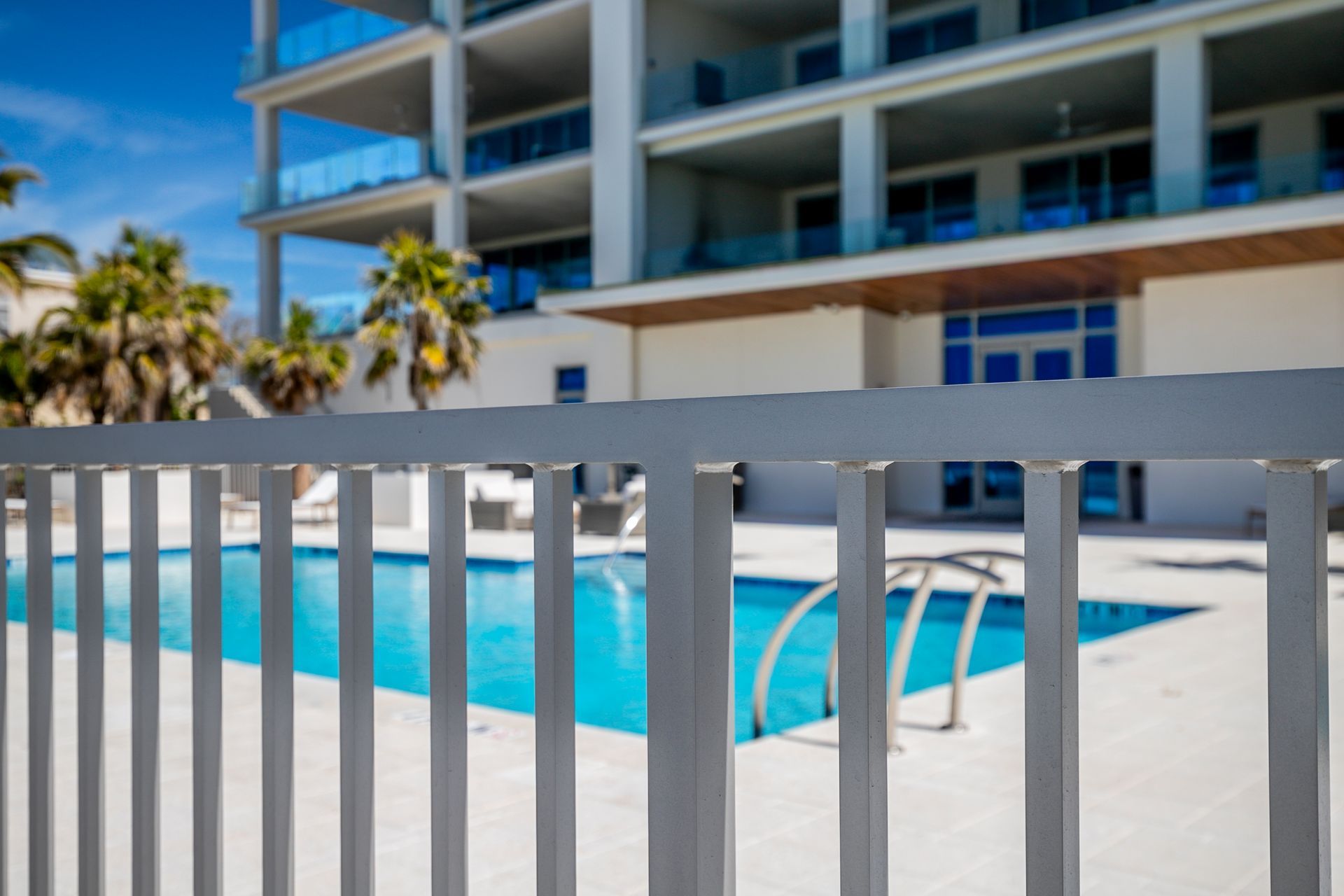
Pool and amenity gates may need self-closing and self-latching hardware, along with specific spacing, height, and latch placement. Those requirements can vary by property and location.
Instead of relying on a general rule, property owners should confirm the current requirements with their contractor and the appropriate local authority before the gate is fabricated.
Choose the Right Width and Height
The gate should be designed around the finished opening, not just a quick measurement between two walls.
The final size may need to account for:
- Posts
- Hinges
- Latch clearance
- Ground clearance
- Slope
- Nearby landscaping
- Columns or walls
- The space needed for the gate to swing
The clear opening also needs to make sense for everyday use.
Will people only walk through it? Will they carry groceries, tools, or equipment? Does the opening need to accommodate a stroller, wheelchair, trash bin, or maintenance cart? There is no single width that works for every pedestrian gate.
A narrow garden entrance and a commercial walkway have very different needs. The dimensions should reflect how the entrance will actually be used. Height matters too.
A lower gate may define a space without blocking the view. A taller gate may provide more privacy and controlled access, but it may also be heavier and more exposed to wind.
The gate should also look proportionate to the surrounding fence, columns, or walls.
Decide Which Way the Gate Should Swing
Swing direction can affect safety, convenience, and how much usable space is left around the entrance.
A gate should not open into a public walkway, strike a nearby door, interfere with steps, or block a narrow path.
Things to review include:
- Normal foot traffic
- Walkway width
- Property boundaries
- Nearby plants
- Steps or uneven ground
- Doors and other gates
- Self-closing hardware
- Emergency exit needs
There is no one answer for every property.
Some gates work better swinging inward. Others need to swing outward. The correct direction depends on the layout and the purpose of the entrance. This should be decided early because it affects hinge placement, latch position, and access-control hardware.
Balance Privacy and Visibility
The amount of open space in the gate changes both its appearance and its performance.
A more open gate provides visibility and airflow. A more closed design creates privacy but may add weight and catch more wind.
Open Picket Gates
Open picket gates are common because they work with many architectural styles and pair well with aluminum fencing.
They allow:
- Better airflow
- Visibility through the entrance
- A more subtle appearance
- Easier visual monitoring
- A consistent look with nearby fencing
Picket spacing still needs careful planning.
The openings can affect pet containment, child safety, climbing, and how easily someone can reach the latch from the other side.
Semi-Private Gates
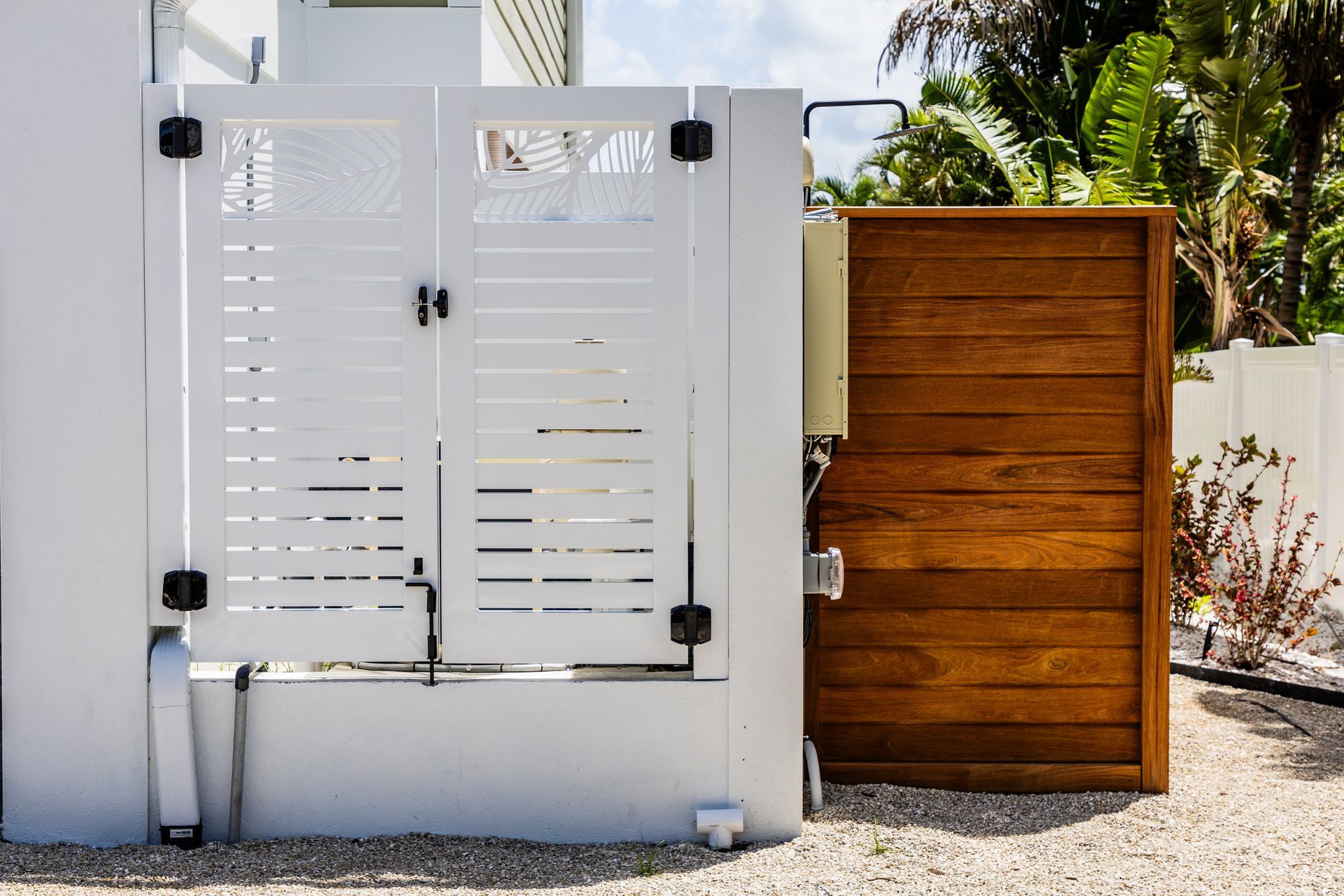
A semi-private gate may use narrow picket spacing, horizontal slats, vertical slats, louvers, or decorative panels.
This can reduce direct visibility without making the gate completely solid. It is often an effective choice for courtyards, side yards, service areas, and residential entrances where some privacy is wanted without closing off the space entirely.
Privacy-Focused Gates
A solid or nearly solid gate provides more visual screening.
It may also require:
- A stronger frame
- Heavier-duty hinges
- Better-supported posts
- More attention to alignment
- Additional consideration of wind exposure
This is especially important in Sarasota, where outdoor gates may be exposed to strong weather and coastal conditions.
A privacy panel should not simply be added to a gate frame that was designed for an open picket layout. The added surface area changes how the gate behaves.
Match the Gate to the Property
A custom gate should feel like part of the property, not something added at the last minute.
The design may take cues from:
- Existing fencing
- Aluminum railings
- Driveway gates
- Exterior paint colors
- Doors and windows
- Masonry columns
- Rooflines
- Landscaping
Common styles include:
- Vertical pickets
- Flat-top gates
- Arched gates
- Horizontal slats
- Geometric patterns
- Decorative scrollwork
- Louvered panels
- Minimalist frames
- Custom initials or logos
A gate does not need a complicated design to look custom.
Sometimes the biggest difference comes from proper proportions, even spacing, clean welds, and a powder coat color that works with the rest of the property.
Build the Frame for the Actual Gate
The frame is what keeps the gate square and aligned.
If the frame is not designed for the gate’s width, height, weight, and hardware, the gate may begin to sag.
That can lead to:
- Difficulty closing
- Latch misalignment
- Dragging on the ground
- Uneven gaps
- Premature hinge wear
- Poor self-closing performance
A tall gate, wide gate, or privacy gate may need more reinforcement than a smaller open picket gate.
The same applies when decorative panels, electronic locks, or heavier hardware are added.
The fabricator should determine the appropriate frame size, material thickness, bracing, and reinforcement for the finished design. This is one of the biggest advantages of custom fabrication. The structure can be designed around the actual project instead of relying on a standard frame.
Check the Posts and Mounting Points
Even a well-built gate will have problems if the posts or columns supporting it are unstable.
Pedestrian gates may be attached to:
- Aluminum posts
- Masonry columns
- Concrete walls
- Existing fence posts
- Structural framing
- Building walls
An existing fence post is not automatically strong enough to carry a gate.
Fence posts may hold panels without issue but still move once they are exposed to the repeated weight and motion of an opening gate.
Before fabrication begins, the installer should review:
- Post or column condition
- Gate weight
- Anchor points
- Hinge load
- Alignment
- Soil or concrete conditions
- Available space for hardware
If the support moves, the gate can sag, shift, or stop latching properly even when the gate itself was built correctly.
Use Hinges That Match the Gate
Hinges are not a one-size-fits-all decision. The right hinge depends on:
- Gate width
- Gate height
- Total weight
- Frequency of use
- Mounting surface
- Swing angle
- Self-closing requirements
- Need for future adjustment
A small side-yard gate may use different hardware from a gate at a busy apartment entrance.
Depending on the project, adjustable hinges, heavy-duty hinges, or self-closing hinges may be appropriate.
The goal is not to choose the largest hinge available. It is to choose hardware that works with the frame, posts, and expected use.
Compare Latches and Locks
Not every gate needs the same level of security.
Some gates only need to stay closed. Others must limit access or work with a larger security system.
Basic Latches
A basic latch may be enough for a garden gate, backyard entrance, or area where the main concern is keeping the gate shut.
Options may include gravity latches, lever latches, and self-latching hardware.
Placement matters. The latch should be convenient for authorized users without becoming too easy to reach from the opposite side.
Keyed Locks
Keyed locks may work well for side yards, courtyards, utility areas, and service entrances.
Before choosing one, think about:
- Whether access is needed from both sides
- Who will have keys
- Weather exposure
- Lock placement
- Frame reinforcement
- Ease of use
Mechanical Keypads
Mechanical keypads provide keyless entry without requiring power.
They may be useful for rental properties, shared residential spaces, service access, and employee entrances.
The owner should still consider how codes will be managed, who receives them, and how often they will be changed.
Electronic Access Control
Some pedestrian gates need to support:
- Electronic keypads
- Card readers
- Key fobs
- Intercoms
- Telephone entry systems
- Electric strikes
- Magnetic locks
- Request-to-exit devices
These systems should be discussed before the gate is built.
The selected hardware may affect the frame size, reinforcement, wiring path, lock preparation, and placement of nearby equipment.
Adding access control after fabrication may require cutting, rewelding, or modifying the gate.
The fabricator and access-control provider should coordinate early so the gate is prepared correctly from the beginning.
Consider Reach-Through and Climbing Risks
A secure lock is only one part of the design.
The gate should also be reviewed from both sides to see how someone may approach it.
Things to consider include:
- Picket or slat spacing
- Distance between openings and the latch
- Gate height
- Lock covers
- Latch guards
- Horizontal elements that may act as footholds
- Nearby walls, boxes, or landscaping
- Keypad and release-button placement
The goal is to make the gate difficult to misuse without making it inconvenient for the people who are allowed to enter.
Consider Self-Closing and Self-Latching Hardware
Self-closing hardware can help prevent a gate from being left open.
This may be important for:
- Pool areas
- Apartment amenities
- Pet areas
- Child-sensitive spaces
- Commercial entrances
- Controlled-access properties
The closer must be matched to the size and weight of the gate. Wind, hinge adjustment, closing speed, and latch alignment all affect whether the gate closes completely.
A gate that moves toward the latch but stops before engaging it is not doing its job. The system should be tested after installation from several opening positions.
Make the Gate Easy to Use
Security should not make the entrance unnecessarily difficult for authorized users.
The design should consider:
- Clear opening width
- Handle location
- Ground clearance
- Thresholds
- Lighting
- Maneuvering space
- Keypad visibility
- Ease of opening
- Use while carrying bags or equipment
- Access for mobility devices
Commercial and public-facing properties may have accessibility requirements that need to be reviewed for the actual site.
A gate should not be described as compliant based on appearance alone. Width, operating force, handle placement, approach space, and the surrounding walkway all matter.
Choose a Finish for Sarasota Conditions
Outdoor gates in Sarasota may be exposed to sun, heat, rain, humidity, irrigation, and salt in coastal air.
Powder coating is commonly used on aluminum gates because it provides a consistent finish and a wide range of colors.
It can also help the gate match nearby:
- Fences
- Railings
- Window frames
- Driveway gates
- Exterior finishes
Aluminum is corrosion resistant, but it is not completely immune to wear.
The gate should still be cleaned and inspected from time to time.
Look for:
- Dirt buildup
- Scratches
- Loose fasteners
- Hinge wear
- Latch misalignment
- Damaged coating
- Hardware that no longer moves smoothly
The hardware should also be suitable for outdoor use.
Common Pedestrian Gate Mistakes
Many gate problems can be traced back to decisions made before fabrication.
Common mistakes include:
- Ordering the gate before confirming final measurements
- Forgetting to check the full swing path
- Mounting the gate to a weak existing post
- Using hinges that are not suited to the gate’s weight
- Planning electronic access after the gate is built
- Ignoring sloped or uneven ground
- Adding privacy panels without considering wind
- Placing the latch too close to large openings
- Forgetting about carts, strollers, or mobility devices
- Choosing style without thinking about daily use
- Failing to match the gate with the surrounding fence or railing
- Using a frame that is too light for the design
Planning these details early can reduce modifications, delays, and future alignment problems.
When Is a Custom Gate Worth It?
A prefabricated gate may be enough for a standard opening with basic requirements.
A custom gate is usually more useful when:
- The opening is an unusual size
- The ground slopes
- The gate must fit between existing columns
- The design must match a fence or railing
- Special locks are needed
- Access-control hardware will be installed
- The entrance receives frequent traffic
- The owner wants more privacy
- HOA or architectural standards apply
- A standard gate would require major modification
The real value of a custom gate is not just the appearance.
It is the ability to plan the dimensions, frame, hardware, finish, and mounting method together.
What Should You Give the Fabricator?
Before requesting an estimate, gather as much useful information as possible.
This may include:
- Photos of the opening
- Approximate width and height
- Property address
- Intended use
- Expected traffic
- Preferred privacy level
- Design inspiration
- Preferred color
- Locking requirements
- Access-control plans
- Existing posts, walls, or columns
- Ground slope
- Nearby landscaping
- HOA requirements
- Desired timeline
Photos and rough measurements are helpful for an initial discussion, but a professional site measurement may still be necessary before fabrication.
Work With a Custom Aluminum Gate Fabricator in Sarasota
A pedestrian gate works best when it is treated as a complete system.
The frame, posts, hinges, latch, lock, finish, and swing direction all affect how the gate performs.
Freedom Aluminum works with homeowners, contractors, property managers, businesses, and communities throughout the Sarasota area.
Depending on the project, the process may include:
- Site evaluation
- Custom measurements
- Design consultation
- 3D CAD review
- Aluminum fabrication
- Hardware preparation
- Powder coating
- Installation
- Final alignment
Pedestrian gates can also be designed to coordinate with driveway gates, aluminum railings, fences, and other custom aluminum features.
Contact Freedom Aluminum to discuss your project and request a custom aluminum pedestrian gate estimate in Sarasota, Florida.