Can an Existing Aluminum Gate Be Automated?
Yes. Many existing aluminum gates can be automated without replacing the entire gate. But whether your gate is a good candidate depends on its condition, how it moves, the strength of its supporting structure, available clearance, and whether it can safely accommodate a gate operator and access-control system.
A gate that already operates smoothly may only need the appropriate automation system and mounting preparation. A gate that sags, drags, binds, or has weak posts may need repairs or reinforcement before automation is added.
For Sarasota property owners, the better question is not simply, “Can a motor be attached to this gate?”
It is:
Can the entire existing gate system handle repeated automated operation safely and reliably?
What Does It Mean to Retrofit an Existing Gate?
Retrofitting means adding automation to a gate that is already installed rather than replacing it with a completely new automatic gate.
Depending on the property and gate configuration, an automation retrofit may involve:
- A gate operator
- Operator mounting hardware
- Electrical and control equipment
- Required safety devices
- Access-control devices
- Manual-release components
- Fabrication or reinforcement of parts of the existing gate
This is why gate automation should be viewed as a complete system rather than simply adding a motor.
The gate, frame, posts, hinges, rollers, track, operator, safety equipment, and access controls all need to work together.
What Needs to Be Checked Before an Existing Aluminum Gate Is Automated?
Before choosing an operator, the existing aluminum gate should be evaluated mechanically and structurally.
1. The Condition of the Aluminum Gate Frame
The gate frame should be straight, stable, and structurally sound.
Signs that the gate may need attention before automation include:
- Sagging
- Twisting
- Cracked or damaged welds
- Excessive movement in the frame
- Bent or distorted sections
Automation creates repeated movement every time the gate opens and closes. A gate that already has structural problems can place unnecessary strain on the operator and other components.
In some cases, custom aluminum fabrication may be needed to reinforce or modify the existing structure before automation is installed.
2. Gate Posts and Mounting Points
A well-built aluminum gate can still perform poorly if its posts or mounting points are inadequate.
For swing gates in particular, the posts and hinges repeatedly support and guide the gate through each opening and closing cycle.
An evaluation may consider:
- Condition of the posts
- Gate-to-post connections
- Existing columns or mounting surfaces
- Operator mounting locations
- Movement in the supporting structure
Automation should not be used to compensate for unstable posts.
If the supporting structure moves each time the gate operates, the underlying issue should be corrected first.
3. Hinges, Rollers, and Tracks
Different gate configurations depend on different mechanical components.
For a swing aluminum gate, the hinges and pivot points should allow smooth, consistent movement.
For a sliding aluminum gate, the rollers, wheels, guide system, and track need to operate properly.
For a cantilever gate, the support rollers, frame, and counterbalanced portion of the gate must function together correctly.
These components matter because the operator should move a gate that already works mechanically. It should not have to force a poorly maintained gate through its path.
4. Does the Gate Move Freely?
One of the most important things to determine is how easily the gate moves before automation is added.
A manual gate that:
- Scrapes the driveway
- Drags along the ground
- Binds at certain points
- Requires significant force to open
- Moves unevenly
- Frequently falls out of alignment
should be evaluated and corrected before adding an operator.
A gate operator should not be used to overcome excessive resistance or compensate for a gate that sticks, drags, or binds.
Installing automation does not fix poor alignment, damaged hinges, worn rollers, weak posts, or structural sagging.
What Types of Existing Aluminum Gates Can Be Automated?
Several common aluminum gate configurations may be suitable for automation.
Swing Aluminum Gates
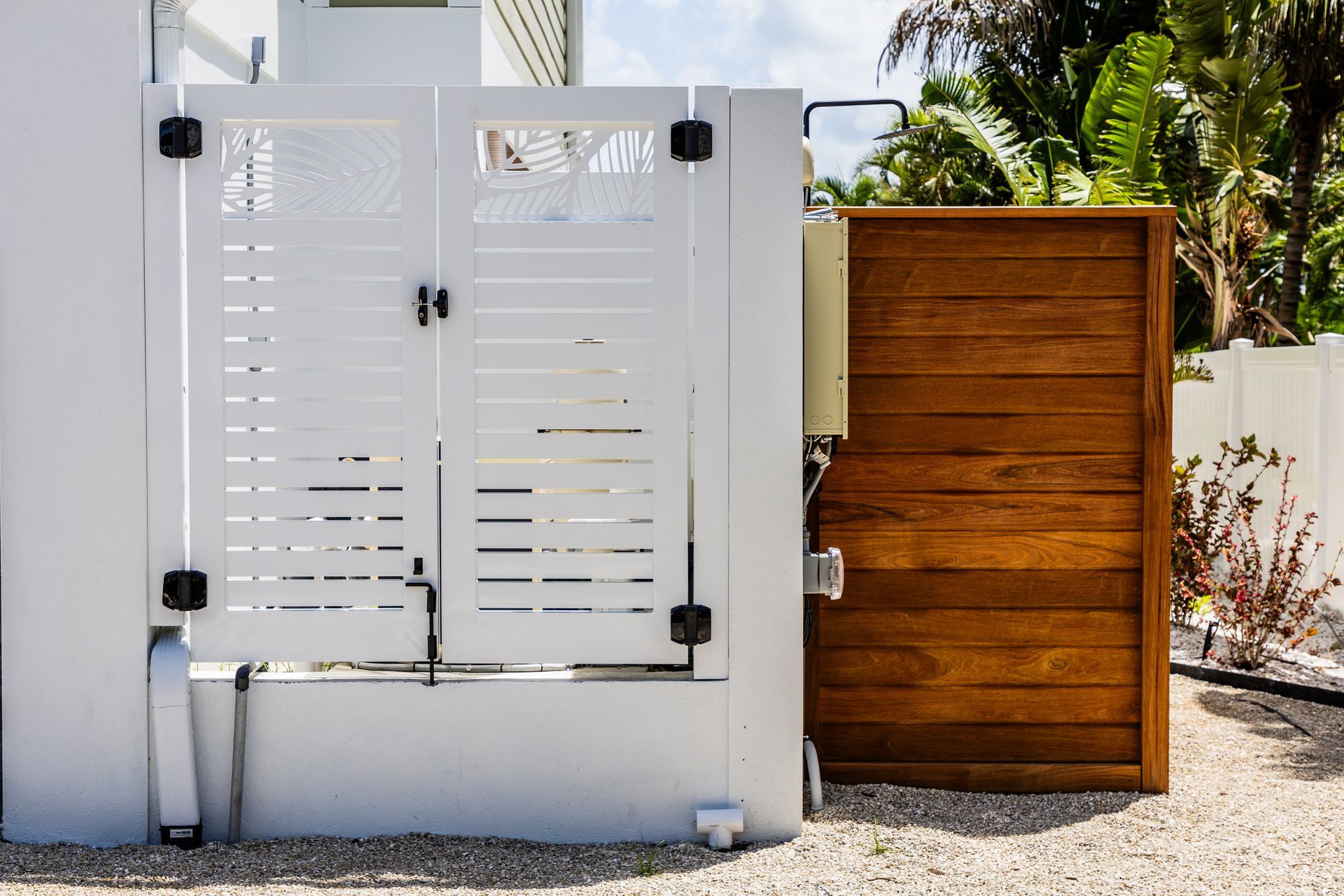
Single-swing and double-swing gates can often be automated when the gate, posts, hinges, and surrounding space are suitable.
The property also needs enough room for the gate to complete its swing without interfering with vehicles, walls, landscaping, or other structures.
For properties with limited entrance space, choosing between a single-swing vs. double-swing aluminum gate can also affect how practical automation will be.
Sliding Aluminum Gates
Sliding gates move sideways rather than into or out of the driveway.
Before automating an existing sliding gate, the system should be evaluated for:
- Track condition
- Rollers or wheels
- Guide components
- Available side clearance
- Operator mounting
- Alignment throughout the gate's travel
A sliding gate that frequently jumps, sticks, or becomes difficult to move may need mechanical corrections first.
Cantilever Gates
Cantilever gates do not rely on a ground track across the driveway. Instead, the gate is supported by a roller system and includes a counterbalanced section.
These gates can also be automated, but the support structure, gate geometry, rollers, and available space need to be evaluated carefully because the entire system functions as one assembly.
Does the Existing Gate Need to Be Modified?
Sometimes.
An existing aluminum gate may be in generally good condition but still need modifications to accommodate automation.
Depending on the gate, these modifications may involve:
- Reinforcing part of the frame
- Creating appropriate operator mounting points
- Repairing damaged welds
- Correcting alignment
- Improving hinge or roller performance
- Modifying supporting components
This is where working with a company that understands both custom-built aluminum gates and automation can be valuable.
The automation equipment cannot be treated separately from the aluminum structure carrying it.
If physical changes are needed, fabrication work may be required before an operator can be installed correctly.
Gate Size, Usage, and Wind Exposure Matter Too
Operator selection is not based on one measurement alone.
Several factors can affect gate performance and automation-system design, including:
- Gate size
- Gate construction
- Gate weight
- Opening configuration
- Expected cycle frequency
- Site conditions such as wind exposure
Wind can be particularly relevant for Sarasota properties.
An open-picket aluminum gate allows more air to pass through it, while a solid or closely spaced privacy gate presents more surface area to the wind.
That does not mean a privacy gate cannot be automated. It means the gate design, structure, operator, and site exposure should be considered together.
This can be especially important on coastal or highly exposed properties.
How Much Clearance Does an Automatic Gate Need?
Automation equipment also requires physical space.
For swing gates, the entrance needs a clear swing path. The operator itself also requires an appropriate mounting location.
For sliding gates, there needs to be enough room beside the driveway for the gate to travel.
Potential obstacles may include:
- Walls
- Columns
- Landscaping
- Parked vehicles
- Sloped driveways
- Drainage features
- Property boundaries
A property with a tight entrance may need a different gate configuration rather than simply adding automation to the existing layout.
If space is limited, reviewing the best gate type for a narrow driveway can help determine whether the current configuration is still practical.
What About Power and Access Control?
Once the gate itself has been evaluated, the automation infrastructure can be considered.
An automatic gate system may include:
- Power supply
- Control equipment
- Backup power
- Manual release
- Entrapment-protection devices
- Access-control hardware
The exact setup depends on the operator, gate configuration, property, and how the owner wants the entrance to function.
Automation can also be combined with different access-control options, such as:
- Remote controls
- Keypads
- Intercom systems
- Key fobs
- Card access
- Vehicle detection
- Other controlled-entry systems
The goal is to create one coordinated system rather than adding unrelated components over time.
What Safety Features Does an Automated Gate Need?
Safety is an essential part of any gate automation project.
Automated vehicular gates require appropriate entrapment protection. Depending on the gate configuration and the entrapment zones identified around the system, protection may involve:
- Monitored photoelectric sensors
- Sensing edges
- Inherent obstruction-detection features
- Other compatible entrapment-protection devices
The exact safety devices required should be determined according to the gate configuration, operator manufacturer's instructions, and applicable requirements.
Automated vehicular gate systems should be designed and installed in accordance with applicable requirements, including UL 325 for gate operators and ASTM F2200 for automated vehicular gate construction, along with any locally adopted codes.
For property owners, the practical takeaway is simple:
An automatic gate is a controlled moving system that requires appropriate safety protection. It should not be treated as a manual gate with a motor attached.
When Is Replacing the Gate Better Than Automating It?
Retrofitting does not always make financial or practical sense.
A new custom aluminum driveway gate may be worth considering when the existing gate:
- Has significant structural damage
- Repeatedly sags or twists
- Requires extensive reinforcement
- Has inadequate posts or supporting structures
- Does not fit the available driveway clearance
- Has poor geometry for automation
- Was originally fabricated poorly
- No longer matches the owner's needs
For example, imagine an existing swing gate that needs new posts, major frame reinforcement, new hinges, alignment corrections, and several modifications before an operator can even be installed.
At that point, the property owner may want to compare the cost of retrofitting with the cost and long-term value of a new gate designed for automation from the beginning.
On the other hand, a well-built gate that only needs minor preparation may be a good retrofit candidate.
Existing Gate Automation vs. a New Automatic Gate
A simple way to think about the decision is:
| Existing Gate Condition | Possible Direction |
|---|---|
| Gate is straight and moves smoothly | Retrofit may be practical |
| Frame is sound but needs mounting reinforcement | Modify and automate |
| Hinges or rollers need repair | Repair before automation |
| Gate sags, binds, or drags | Structural evaluation first |
| Entrance has poor clearance | Consider another configuration |
| Extensive structural work is required | Compare retrofit vs. replacement |
| New gate is already planned | Design automation into the new gate |
There is no universal answer.
The right decision depends on how much work the existing gate needs before it can become a reliable part of an automated system.
Sarasota Conditions Should Be Part of the Evaluation
Automatic gates in Sarasota operate outdoors year-round.
That means the gate and automation system may be exposed to:
- Heat
- Humidity
- Heavy rain
- Salt air in coastal areas
- Wind
- Storm conditions
- Standing water or drainage issues
These conditions should be considered when evaluating gate hardware, automation equipment, fabrication, electrical components, and long-term durability.
A reliable automated gate depends on more than the operator alone.
Evaluating an Existing Aluminum Gate for Automation
If you already have an aluminum gate and are considering automation, a professional evaluation can help determine whether retrofitting is practical or whether repairs, structural modifications, or replacement should be considered first.
An evaluation may include:
- Identifying the gate type and configuration
- Checking the aluminum frame
- Evaluating posts and mounting points
- Inspecting hinges, rollers, or tracks
- Testing how smoothly the gate moves
- Reviewing available clearance
- Determining whether fabrication modifications are needed
- Discussing automation and access-control goals
- Comparing retrofit and replacement options when necessary
Freedom Aluminum specializes in custom aluminum gates and integrates automation and access-control options into its gate projects.
Have an existing aluminum gate? Contact Freedom Aluminum to discuss the gate's condition and configuration and determine what options may be available for your Sarasota property.
Frequently Asked Questions
Can you add a motor to an existing aluminum gate?
Often, yes. The gate should first be evaluated for structural condition, alignment, movement, mounting requirements, clearance, and compatibility with the planned automation system.
Can an existing swing gate be automated?
Many swing gates can be automated if the frame, hinges, posts, swing path, and supporting structure are suitable.
Can an existing sliding aluminum gate be automated?
Potentially. The track, rollers, guide system, alignment, available side clearance, and operator location should all be evaluated before automation is added.
Do I need to replace my gate posts before adding automation?
Not necessarily. Existing posts should first be evaluated to determine whether they are suitable for the existing gate and planned automation system.
Can I add a keypad or remote to my existing aluminum gate?
Access-control options such as keypads, remotes, intercoms, card systems, and other entry controls may be integrated depending on the operator, gate configuration, and property requirements.
What if my existing gate sags or drags?
The underlying problem should be corrected before automation is installed. A gate operator should not be used as a solution for structural damage, poor alignment, worn hinges, malfunctioning rollers, or a gate that binds.
Is it better to automate an existing gate or install a new automatic gate?
It depends on the existing gate's condition and configuration. If only minor modifications are needed, retrofitting may be practical. If extensive structural work is required, a new gate designed specifically for automation may provide a better long-term solution.