5 Practical Aluminum Railing Styles in Sarasota, FL
The most practical aluminum railing styles for Sarasota properties include vertical picket railings, horizontal slat railings, cable systems with aluminum frames, glass-panel systems, and custom welded aluminum railings.
But choosing the right railing involves more than deciding which one looks best.
A waterfront balcony may prioritize an open view, while a stairway requires a configuration designed around its geometry and function. A patio may benefit from additional screening, while a commercial walkway may call for something simpler and highly functional.
For Sarasota property owners, the right railing should balance application, architecture, visibility, outdoor exposure, maintenance, and applicable building requirements.
What Makes a Railing Style Practical in Sarasota?
A practical railing should work for the space where it will actually be installed.
Before choosing a design, consider:
- Where the railing will be located
- Whether it will function as a guard, handrail, or another type of barrier
- How much visibility or privacy you want
- The architecture of the property
- Outdoor and coastal exposure
- Cleaning and maintenance expectations
- Applicable building and permitting requirements
These factors may lead to very different railing choices.
For example, a Sarasota Bay-facing balcony may benefit from a railing that minimizes visual obstruction. A front porch may need something that suits the home's architecture. Stairs may require a project-specific configuration because of changes in elevation, angles, landings, and attachment points.
Five practical railing styles to consider.
1. Vertical Picket Aluminum Railings
Vertical picket railings are among the most adaptable railing configurations for residential and commercial properties. The typical design consists of aluminum posts and rails with vertical pickets or balusters between them. Because of their straightforward geometry, they can work with a wide range of architectural styles.
Where Vertical Picket Railings Work Well
They are commonly considered for:
- Balconies
- Decks
- Porches
- Stairways
- Walkways
- Multifamily properties
- Commercial spaces
Their relatively open design maintains visibility while still creating a clearly defined edge or barrier.
They can also be fabricated in different profiles, dimensions, spacing arrangements, and finishes depending on the architectural requirements of the property.
Why Custom Fabrication Can Help
Prefabricated sections may work well for simple layouts, but existing structures are not always perfectly uniform. Custom fabrication becomes particularly useful when a railing needs to accommodate these requirements:
- Nonstandard dimensions
- Stair angles
- Corners and transitions
- Existing structural conditions
- Specific architectural details
Vertical pickets provide a practical starting point in Sarasota because the design is relatively simple without limiting customization.
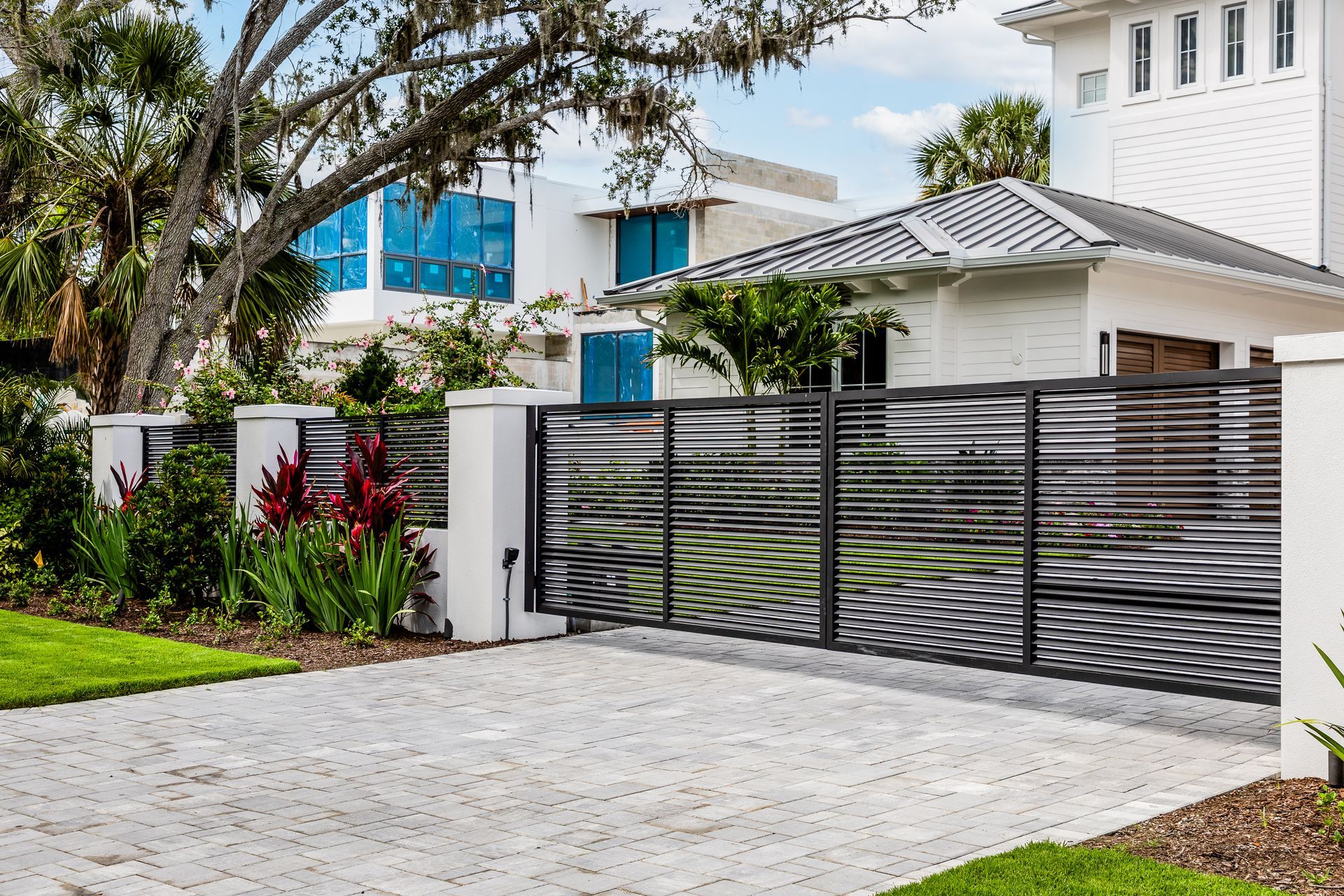
2. Horizontal Slat Aluminum Railings
Horizontal slat railings use aluminum members running across the railing rather than traditional vertical pickets. The result is a distinctly contemporary appearance.
They can be especially useful when the goal is to create more visual separation without completely enclosing an outdoor space.
Where Horizontal Slat Railings Work Well
Common applications may include:
- Contemporary Sarasota homes
- Patios
- Terraces
- Entry areas
- Outdoor living spaces
- Architectural screening applications
Changing the width and spacing of the slats can significantly alter how the railing performs visually.
Wider or more closely spaced slats may create greater screening, while larger spaces between members maintain a more open appearance.
This gives designers and property owners flexibility when balancing privacy, airflow, visibility, and architecture.
Are Horizontal Railings Appropriate Everywhere?
Not necessarily. The configuration of a railing can affect whether it is suitable for a particular location, especially around elevated areas, stairs, children-accessible spaces, or pools.
Rather than assuming a horizontal design will work everywhere, the proposed configuration should be evaluated against the requirements that apply to the particular project.
That is especially important when a visually appealing architectural feature also needs to function as a required guard or barrier.
3. Cable Railings With Aluminum Frames
For properties where visibility is a major consideration, cable railing with a fabricated aluminum frame can provide a much more open appearance.
Instead of filling most of the railing area with aluminum pickets, horizontal cables create narrow visual lines between the posts.
Where Cable Railings Work Well
Potential applications include:
- Waterfront homes
- Balconies
- Elevated decks
- Terraces
- Contemporary residential properties
This can be particularly appealing when a railing sits between an outdoor living space and a desirable view.
For example, a deck overlooking Sarasota Bay or another waterfront setting may benefit from a railing system that does not visually dominate the edge of the property.
Cable Railing Requires More Than a Good View
Cable systems need careful planning. These are the important considerations to note:
- Post spacing
- Cable tension
- Frame rigidity
- Connection points
- Opening requirements
- Compatible hardware
- Maintenance
The aluminum frame and cable infill also need to work as a complete system.
For coastal properties, material compatibility and exposure should be considered when selecting hardware and finishes. Aluminum itself does not rust like ferrous steel, but that does not mean an outdoor railing is immune to corrosion, surface changes, or maintenance requirements.
Properties with greater salt exposure may require more attention to material selection, finishing, detailing, and routine cleaning.
4. Glass Panel Railings With Aluminum Frames
Glass railing systems use glass panels supported by aluminum posts, channels, or other fabricated framing.
For homeowners who want as little interruption as possible between an outdoor space and its surroundings, glass is one of the most visually open options.
Where Glass Railings Work Well
They may be considered for:
- Waterfront balconies
- Terraces
- Custom residences
- Multifamily properties
- Hospitality properties
- Other view-oriented spaces
Glass can maintain a very open appearance while still creating a physical barrier around a balcony or terrace.
It may also provide more wind screening than an open picket or cable configuration, although actual wind performance depends on the specific system and engineering of the installation.
What Are the Trade-Offs?
The view comes with additional maintenance considerations.
Compared with an open railing, glass can make the following more noticeable:
- Fingerprints
- Water spots
- Rain residue
- Salt deposits
- Dust and debris
Glass specifications and attachment methods also need to be appropriate for the application.
For this reason, glass railings should be evaluated as a complete system involving the glass, aluminum framing, connections, structural requirements, and installation conditions rather than simply as an architectural feature.
5. Custom Welded Aluminum Railings
Not every property fits neatly into a standard picket, cable, glass, or horizontal-slat system.
That is where custom welded aluminum railings become particularly useful.
Instead of selecting a predetermined railing kit and adapting the property around it, a custom railing can be fabricated around the dimensions and architectural characteristics of the project.
Where Custom Railings Make Sense
Applications may include:
- Custom homes
- Front entrances
- Porches
- Stairways
- Irregular balconies
- Architectural features
- Commercial properties
- Mediterranean-inspired or traditionally styled Sarasota homes
Custom fabrication can change more than the decorative pattern.
Fabricators can modify elements such as:
- Post profiles
- Rail profiles
- Baluster arrangements
- Corners
- Stair transitions
- Geometric patterns
- Panel dimensions
- Finishes
This makes custom fabrication useful when the building itself has unusual geometry or when the railing needs to complement a specific architectural design.
Which Aluminum Railing Style Fits Your Project?
Here is a simple comparison of the five options:
| Railing Style | Visibility | Privacy Potential | Common Applications | Architectural Fit |
|---|---|---|---|---|
| Vertical Picket | Good | Low | Stairs, decks, balconies | Traditional to contemporary |
| Horizontal Slat | Moderate | Moderate to high | Patios, terraces, modern homes | Contemporary |
| Cable + Aluminum Frame | Very high | Low | Waterfront decks and balconies | Modern |
| Glass + Aluminum Frame | Maximum | Low | Balconies, terraces, view-oriented properties | Contemporary / luxury |
| Custom Welded Aluminum | Variable | Variable | Stairs, entrances, custom architecture | Highly adaptable |
There is no single railing style that works best for every Sarasota property. The application should drive the choice.
Which Railing Works Best for Different Sarasota Applications?
Looking at the project by location can make the decision easier.
Balconies
Balcony railings need to balance safety requirements with architecture and visibility. Possible options include:
- Vertical picket railings
- Cable systems
- Glass-panel systems
For balconies overlooking the Gulf, Sarasota Bay, a canal, or another attractive view, maintaining sightlines may have a greater influence on the design.
Decks
Deck railings typically need to work with both the structure and the surrounding outdoor living space.
Vertical pickets provide a straightforward solution, while cable systems can maintain a more open view.
Custom fabrication may be appropriate when the deck has unusual dimensions, angles, stairs, or transitions.
Stairs
Stair railings require additional attention because the system has to follow changes in elevation and geometry.
Depending on the project, considerations may include:
- Handrail requirements
- Graspability
- Landings
- Transitions
- Attachment points
- Stair angles
This is an area where project-specific fabrication can be particularly useful.
Waterfront Properties
For Sarasota waterfront properties, railing selection often involves balancing two priorities:
Preserving the view and designing for the environment.
Cable and glass systems can minimize visual obstruction, while traditional picket systems remain an option where a simpler railing is preferred.
Properties closer to saltwater may also experience greater salt exposure, making appropriate finishes, material compatibility, detailing, and routine maintenance important considerations.
Commercial Properties
Commercial railings may prioritize different factors than residential projects.
Depending on the building, designers may need to consider:
- Pedestrian traffic
- Accessibility
- Durability
- Maintenance
- Building architecture
- Required guard and handrail functions
The final configuration should reflect how people will actually interact with the space.
What About Aluminum Railings Around Pools?
Aluminum can also be used for railing or barrier systems near pool areas, but not every railing automatically qualifies as a compliant pool barrier.
Requirements can differ depending on the location and configuration of the system.
Factors such as height, openings, gates, access, and surrounding conditions may affect what is required.
If a railing will also serve as part of a pool barrier, the design should be evaluated specifically for that function rather than assuming a standard deck or balcony railing can be used interchangeably.
Sarasota Building Code and Permitting Considerations
As of September 2026, Sarasota County identifies the 2023 Florida Building Code, 8th Edition among its current codes. Sarasota County states that building applications have been subject to that edition since December 31, 2023.
The Florida Building Commission likewise identifies December 31, 2023 as the effective date of the 8th Edition (2023) Florida Building Code.
Requirements for a railing project can depend on factors including:
- Whether the property is residential or commercial
- Where the railing is installed
- The elevation of the walking surface
- Whether stairs are involved
- The railing configuration
- Structural loading
- Attachment methods
- Whether the system also serves another function, such as a pool barrier
Sarasota County also manages plan review, inspections, permitting, and contractor licensing through its Building Division.
Because requirements vary by project and jurisdiction, property owners should confirm the requirements applicable to their specific installation rather than relying on a general railing dimension found online.
Why Aluminum Works Well for Custom Railings
Aluminum lends itself well to architectural railing fabrication because it can be cut, formed, welded, and finished into many different configurations.
Potential advantages include:
- Flexible fabrication
- Relatively low weight
- Multiple architectural profiles
- Powder-coating options
- Suitability for exterior applications
- Ability to accommodate project-specific dimensions
Aluminum also does not rust in the same way as ferrous steel.
That does not, however, mean that aluminum is corrosion-proof or maintenance-free.
Alloy selection, finishing, installation details, hardware compatibility, environmental exposure, and maintenance can affect long-term performance—particularly in coastal environments.
Custom vs. Prefabricated Aluminum Railings
Prefabricated railing systems can work well when a property has relatively standard dimensions and the available system meets the design requirements.
Custom fabrication becomes more useful when the property itself creates the challenge.
For example, custom aluminum railings may make sense when there are:
- Irregular dimensions
- Custom stair angles
- Multiple corners or transitions
- Existing architectural elements to match
- Nonstandard mounting conditions
- Specific design requirements
Neither approach is automatically better.
Standard railing systems solve standard conditions. Custom fabrication solves project-specific ones.
Choosing the Right Railing for Your Sarasota Property
A simple way to narrow your choices is to start with what matters most for the project.
Want to preserve the view?
Consider cable or glass.
Need a versatile, straightforward railing?
Consider vertical pickets.
Want more visual screening and contemporary architecture?
Consider horizontal aluminum slats.
Have unusual dimensions or a specific architectural concept?
Consider a custom welded aluminum railing.
Then look beyond appearance.
The final decision should also take into account the railing’s location, structural conditions, required function, environmental exposure, maintenance expectations, and applicable building requirements.
Custom Aluminum Railings in Sarasota
A railing should be designed around the property—not the other way around.
Freedom Aluminum provides custom aluminum fabrication for Sarasota-area properties, including fabricated railing solutions designed around the dimensions, architecture, and intended application of the project.
Whether the project involves stairs, balconies, decks, entrances, or other architectural applications, custom fabrication makes it possible to develop a railing configuration around the actual conditions of the property.
Planning a custom aluminum railing project in Sarasota? Contact Freedom Aluminum to discuss the application, design, and fabrication requirements for your property.
Frequently Asked Questions
What type of aluminum railing is best for a Sarasota home?
There is no single best type. Vertical pickets provide broad versatility, horizontal slats can add contemporary screening, cable and glass systems can preserve views, and custom welded railings are useful for unusual dimensions or architectural requirements.
Are aluminum railings good for coastal properties?
Aluminum is commonly used for exterior applications and does not rust like ferrous steel. However, coastal exposure can still affect aluminum finishes, connections, and other system components. Proper materials, finishes, detailing, compatible hardware, and maintenance remain important.
What railing is best for a waterfront view?
Cable railing with an aluminum frame and glass-panel railing systems generally create less visual obstruction than closely spaced solid or picket systems. The right choice also depends on maintenance, architecture, structural requirements, and the specific location.
Can aluminum railings be custom fabricated?
Yes. Custom aluminum railing fabrication can accommodate project-specific dimensions, profiles, corners, stairs, transitions, infill arrangements, and architectural details.
Are horizontal railings allowed in Florida?
Whether a particular horizontal railing configuration is appropriate depends on the project, building type, location, and applicable requirements. The proposed design should be reviewed for the specific installation rather than assuming that every horizontal configuration is acceptable.
Can aluminum railing be used around a pool?
Potentially. If the railing forms part of a required pool barrier, it must meet the requirements applicable to that use. A railing that is suitable for a deck or balcony should not automatically be assumed to satisfy pool-barrier requirements.