Custom Aluminum Shutters in Sarasota | Freedom Aluminum
This is a subtitle for your new post
Why Custom Aluminum Shutters Are a Smart Choice for Coastal Properties
Coastal properties need exterior materials that can handle more than occasional rain. Salt in the air, humidity, strong sunlight, and year-round exposure can be demanding on exterior metalwork, especially on homes and commercial properties close to the water.
This is one reason custom aluminum shutters can make sense for coastal properties. Aluminum does not develop iron rust like steel, can be fabricated into louvered architectural designs, and gives property owners more control over dimensions, shade, privacy, airflow, color, and how the finished feature fits the building.
But there is an important distinction: an aluminum shutter is not automatically a hurricane or impact-rated shutter. Its purpose and performance depend on how the complete system is constructed, tested, manufactured, and installed.
For property owners considering custom exterior aluminum features, here is where aluminum shutters can offer the most value.
Why Coastal Properties Need Different Exterior Materials
A material that performs well inland may face a more demanding environment near the coast. Airborne salt can settle on exterior surfaces, while humidity and moisture create conditions that can accelerate corrosion. Coatings also face exposure to strong sunlight, rain, and changing weather conditions.
That does not mean every coastal aluminum product will automatically last indefinitely. The aluminum alloy, fabrication method, surface preparation, finish, hardware, installation, and maintenance all affect how an exterior feature performs over time.
This makes material and finish selection particularly important for Sarasota and other Gulf Coast properties.
1. Aluminum Does Not Rust Like Steel
One of aluminum’s biggest advantages for exterior applications is that it does not develop the same iron oxide rust associated with steel. Aluminum naturally develops a thin oxide layer that helps protect the underlying metal. This contributes to its corrosion resistance and is one reason aluminum is widely used for gates, railings, screens, shutters, and other exterior architectural features.
However, corrosion resistant does not mean corrosion proof.
In coastal environments, chloride from salt can contribute to localized corrosion, including pitting. Alloy selection, surface preparation, coating, hardware, drainage, installation, and routine cleaning therefore still matter.
For custom exterior aluminum, the complete system should be considered, including:
- aluminum material and profile
- surface preparation
- coating system
- fasteners
- hinges and mounting hardware
- drainage and water collection points
- cleaning and maintenance
The goal is not simply to choose aluminum, but to design an exterior feature that is appropriate for the conditions where it will be installed.
2. Custom Shutters Can Be Designed Around the Property
A standard-size shutter starts with a predetermined product. A custom shutter starts with the building. That difference becomes important when a property has oversized windows, unusual openings, wide elevations, specific architectural proportions, or multiple openings that need to look consistent.
Instead of trying to make an existing product fit the property, custom fabrication can account for the actual:
- opening width and height
- shutter proportions
- frame dimensions
- louver spacing
- mounting points
- viewing angles
- finish
- surrounding architecture
For a large contemporary home, for example, a narrow stock shutter beside an oversized window may look visually disconnected even if it technically fits.
A custom design can instead use proportions that make the shutter appear intentional.
This property-first approach is also relevant to other forms of custom aluminum fabrication. Freedom Aluminum’s current fabrication process includes on-site measurement, project-specific design, 3D CAD planning where required, fabrication, finishing, and installation.
3. Louvered Aluminum Shutters Can Provide Shade
Shutters do not have to completely cover a window to change how sunlight reaches it.
A louvered design uses angled horizontal or vertical elements to interrupt direct sunlight and sightlines while retaining openings between the louvers.
This could be particularly useful on façades that receive substantial direct sun.
Depending on the orientation and louver design, exterior shutters can help create:
- partial shade over windows
- filtered daylight
- less direct solar exposure
- additional shade around outdoor living areas
The exact result depends on the building orientation, shutter projection, louver angle, time of day, and season.
For that reason, certain claims about cooling-cost reductions should not be assumed simply because shutters are installed.
The advantage of custom fabrication is that the louver configuration can be considered in relation to the actual property rather than treating every exposure the same way.
4. Louvers Can Balance Privacy, Light, and Airflow
Privacy is often treated as an all-or-nothing decision: either leave an opening exposed or cover it completely.
Louvers create another option.
The spacing and angle of the slats can reduce a direct line of sight while leaving open space between the individual members. This can help balance three goals that often compete with each other:
privacy → daylight → airflow
A tighter sightline can create more visual separation. A more open configuration can allow greater visibility and air movement.
The right design depends on what the property owner is trying to accomplish.
For example, shutters facing a neighboring property may prioritize privacy, while louvered features around a covered outdoor space may prioritize shade and openness.
This relationship between louver angle, concealment, and airflow is also used in other types of architectural aluminum fabrication.
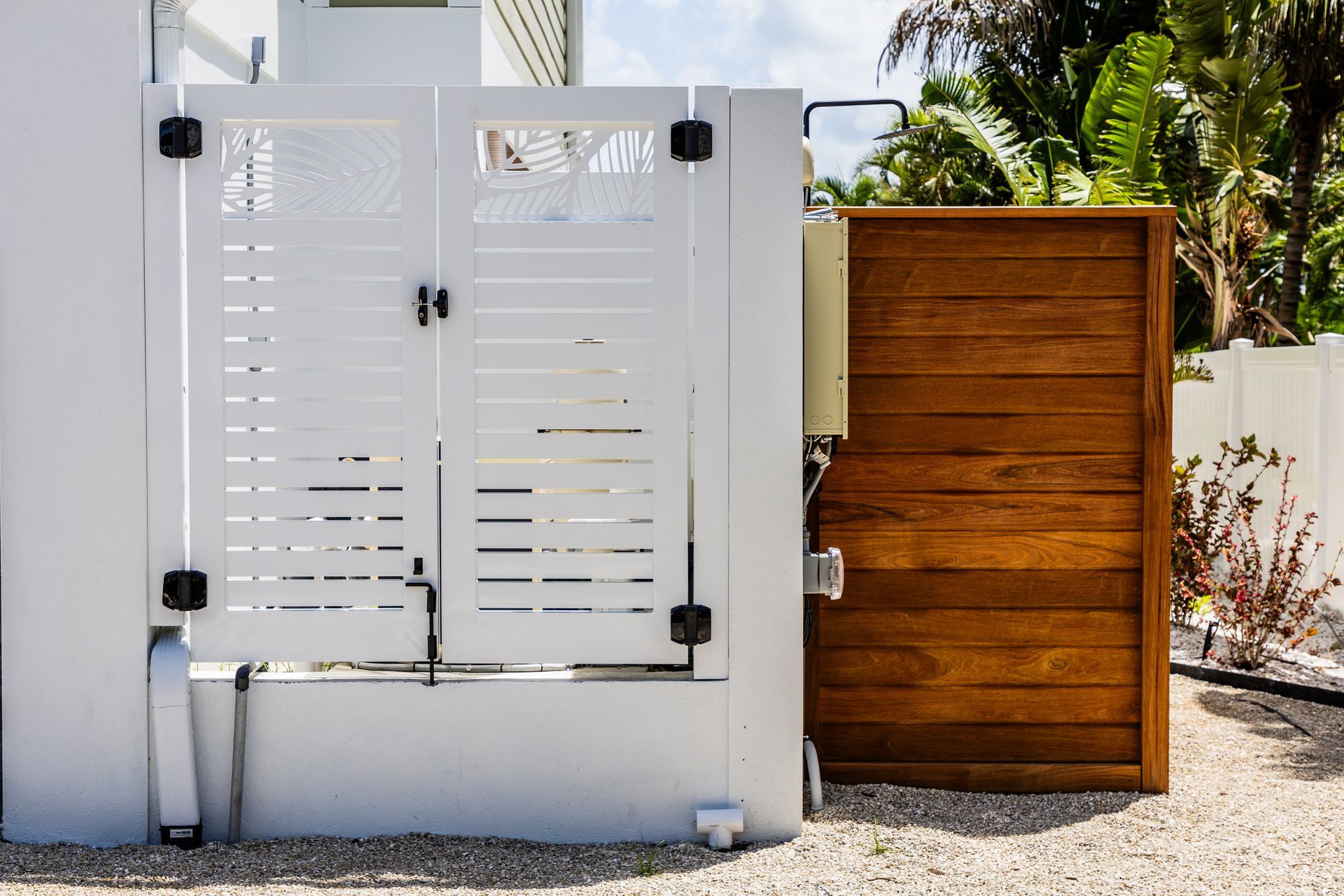
Freedom Aluminum already applies similar principles to its custom louvered equipment screens, where the goal is to reduce visibility of mechanical equipment without unnecessarily restricting the airflow that equipment requires.
The application is different, but the design principle is similar: blocking a direct view does not always require building a solid wall.
5. Custom Aluminum Shutters Can Become Part of the Architecture
Exterior shutters are highly visible. That means their value is not purely functional.
The shape, spacing, finish, frame depth, and proportion of the shutters affect how the entire façade looks.
Custom fabrication gives property owners and designers more freedom to coordinate shutters and other louvered features with elements such as:
- aluminum gates
- railings
- window frames
- exterior trim
- equipment screens
- entry features
- balconies
- other architectural metalwork
A contemporary Sarasota home, for example, may use simple horizontal louvers and a restrained powder-coated finish. A coastal-inspired property may use a more traditional Bahama-style configuration.
The goal does not have to be making the shutter disappear.
In some projects, it can become a deliberate architectural element.
Color and Finish Matter Near the Coast
Architectural aluminum can be finished using coating systems designed for demanding outdoor environments.
Powder coating also provides a wide range of color and finish options, allowing an aluminum feature to blend into the building or create deliberate contrast. But coastal projects should consider more than appearance.
Surface preparation, coating specification, salt exposure, and maintenance could all influence how the finish performs over time.
High-performance architectural coating standards such as FGIA/AAMA 2605 establish demanding performance requirements for coatings used on aluminum extrusions and panels.
That does not mean every powder-coated aluminum product automatically meets this standard. The specific coating system and preparation process should be confirmed for the project.
6. Aluminum Offers Useful Strength Without Excessive Weight
Exterior shutters have to be supported by the building and, depending on their design, may also need to open, close, pivot, or remain projected away from the wall.
Weight therefore matters.
Aluminum’s relatively low weight is one reason it is commonly used for fabricated architectural features. A fabricator can create frames, louvers, panels, and other components without introducing the same weight associated with an equivalent steel feature.
That does not mean aluminum is universally better than steel.
Steel can be appropriate where greater structural capacity or other project-specific characteristics are needed. Aluminum is attractive for many exterior applications because it combines relatively low weight, workability, corrosion resistance, and design flexibility.
The correct material should always follow the requirements of the project rather than a blanket rule.
7. Custom Fabrication Gives Property Owners More Control Over the Final Result
The word custom should mean more than choosing a color from a catalog.
A properly planned fabricated feature can account for the property before metal is cut.
The process may include:
- Evaluating the intended purpose.
- Measuring the opening and surrounding structure.
- Determining dimensions and proportions.
- Choosing the louver arrangement.
- Reviewing mounting and hardware requirements.
- Selecting the material and finish.
- Creating drawings when the project requires them.
- Fabricating the individual components.
- Applying the final finish.
- Installing the completed assembly.
Freedom Aluminum follows a similar project-specific process for its established fabrication services, including on-site measurement, design review, customization, in-house fabrication, and professional installation.
This matters because exterior architectural features rarely exist in isolation. They interact with windows, walls, trim, landscaping, other metalwork, and the overall visual balance of the property.
Are Custom Aluminum Shutters Hurricane Shutters?
Not necessarily.
This distinction is particularly important in Florida.
A shutter being made from aluminum does not automatically make it an impact-resistant hurricane protection system.
Architectural shutters can be designed primarily for:
- shade
- privacy
- exterior design
- architectural screening
A hurricane-protection system has a different performance requirement.
Florida maintains specific product-approval and testing requirements for impact-resistant opening protection. Approved shutter systems may reference standards such as ASTM E1886 and ASTM E1996, along with project-specific installation and design requirements.
Some aluminum Bahama shutter systems are specifically engineered and approved for impact protection.
That approval applies to the tested system, including its components, attachment method, allowable design pressures, and installation requirements. It does not apply automatically to all aluminum shutters or all Bahama-style designs.
As of August 2026, Florida’s current effective building code remains the 8th Edition (2023) Florida Building Code, which took effect
December 31, 2023. The Florida Building Commission is developing the 9th Edition (2026), with the current workplan targeting December 31, 2026, for the new edition’s effective date.
If storm protection is part of the project’s purpose, verify the required product approval, design pressures, testing, installation details, and applicable local code requirements before choosing the shutter system.
Custom Aluminum Shutters vs. Standard-Size Shutters
Neither option is automatically right for every property.
| Consideration | Custom-Fabricated Aluminum Shutters | Standard / Stock Shutters |
|---|---|---|
| Sizing | Designed around the opening | Limited to available dimensions |
| Louver design | Can be project-specific | Predetermined |
| Finish | Greater customization possible | Manufacturer-selected options |
| Unusual openings | Can accommodate project-specific dimensions | May require compromises |
| Architectural integration | Designed around the property | Selected from existing designs |
| Initial cost | Often higher | Often lower |
| Design flexibility | High | More limited |
For a conventional opening where a standard product already provides the right dimensions, appearance, and function, a stock shutter may be perfectly adequate.
Custom fabrication becomes more useful when the property has unusual dimensions or when the owner wants greater control over appearance, louver configuration, mounting, privacy, shade, or finish.
What Should You Consider Before Choosing Aluminum Shutters?
Start with the purpose. Are you primarily trying to create shade? Increase privacy? Add architectural character? Create a functional opening? Or provide approved hurricane protection?
Those goals can lead to very different designs.
Before fabrication, consider:
- the size of each opening
- desired shade
- required privacy
- desired airflow and daylight
- architectural style
- louver angle and spacing
- preferred color and finish
- salt exposure
- hardware and mounting method
- cleaning and maintenance access
- HOA or architectural-review requirements
- local permitting requirements
- whether code-compliant impact protection is required
Answering these questions before design begins is usually easier than trying to modify a finished feature afterward.
Why Work With a Custom Aluminum Fabricator?
A custom louvered exterior feature is ultimately a fabricated architectural system.
That means good results depend on more than the aluminum itself.
Dimensions, welds, frame design, louver spacing, hardware, coating, attachment points, and installation all influence how the finished feature looks and functions.
Working with a custom aluminum fabricator allows the project to begin with the property rather than a predetermined item from a catalog.
Freedom Aluminum designs, fabricates, and installs custom aluminum gates, railings, equipment screens, and other exterior aluminum solutions for residential and commercial properties in Sarasota County.
Its established fabrication process can include on-site measurements, CAD design, custom dimensions, powder-coat color selection, in-house fabrication, and installation.
For property owners considering custom louvered aluminum features, these same capabilities can help determine whether a custom-fabricated solution fits the dimensions, appearance, airflow, privacy, and other requirements of the project.